
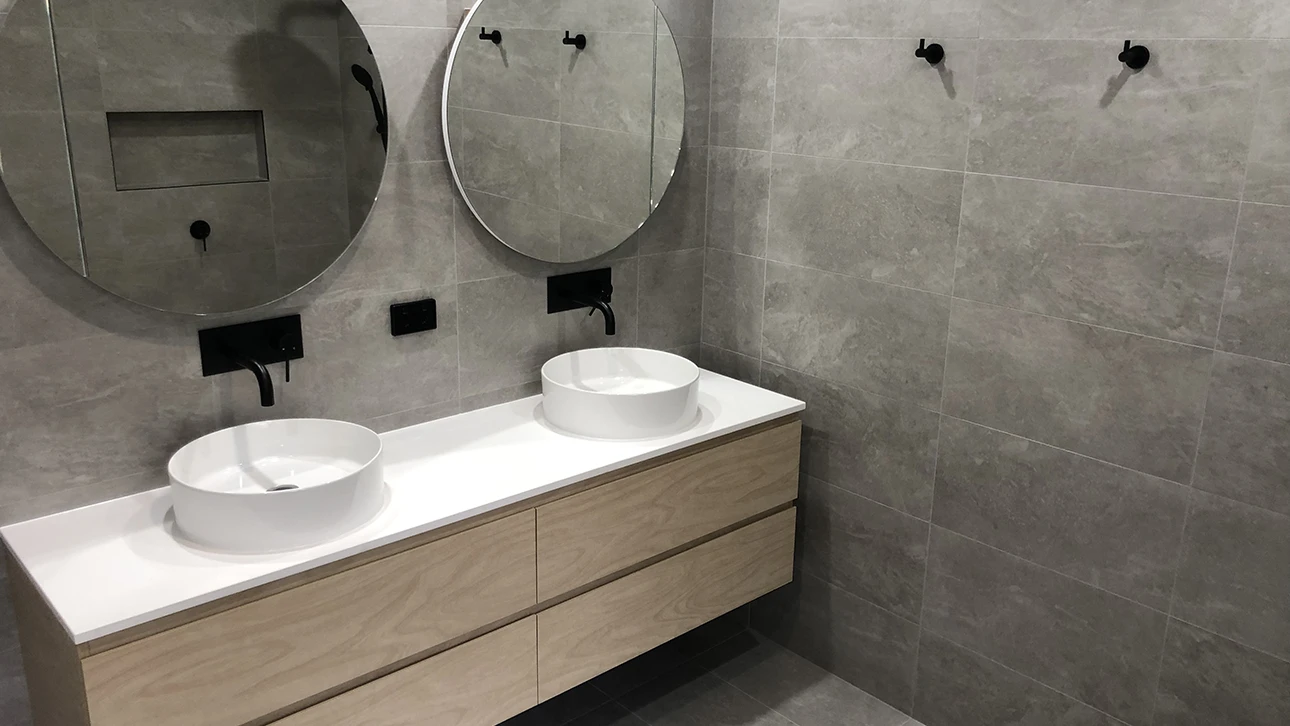
A complete, professionally installed bathroom renovation in Australia costs between $19,980 and $50,000. You cannot fully renovate a bathroom for $10,000 or less. That budget only covers a cosmetic refresh that keeps your existing layout, tiles and waterproofing in place. For a full strip-out with all licensed trades, the realistic minimum spend is $19,980.
Industry data backs this up. The Housing Industry Association puts the national average bathroom renovation at $26,747, up from $21,484 in 2021 (HIA Kitchens and Bathrooms Report). Independent architect body Archicentre Australia prices a complete wet-area bathroom fit-out at $17,500 to $35,000 (Archicentre Australia CostGuide 2026). The Australian Bureau of Statistics valued residential alterations and additions at roughly $3.7 billion in the December 2025 quarter alone (ABS Building Activity).
Bathroom Renovation Cost Calculator
Get a rough estimate for your Sydney bathroom renovation. Every complete Empire Bathrooms renovation starts from $19,980.
Estimated renovation cost
$19,980 to $22,700
A guide range for a standard bathroom with essential finishes.
Get a free design sessionThis is a guide only. Your exact, fixed-price quote is confirmed in writing after a free design session at our Dural showroom.
Can you renovate a bathroom for $10,000?
No. You cannot complete a full bathroom renovation for $10,000 in Sydney. Once you account for licensed plumbing, electrical work and certified waterproofing, plus tiling and fixtures, a $10,000 budget runs out before the job is finished. A complete renovation with all trades starts at a realistic minimum of $19,980.
A $10,000 budget is not a renovation budget in the true sense. It is a cosmetic budget. It can freshen a bathroom that is structurally sound, but it forces compromises the moment you want a complete overhaul. Here is exactly where a $10,000 budget hits its limits:
- No layout change. Moving the toilet, shower or vanity triggers new rough-in plumbing and can consume 30 per cent or more of your funds instantly. If your room is tight, it pays to plan a small bathroom around the existing plumbing before you price anything.
- No floor-to-ceiling tiling. You are limited to partial tiling or feature strips, because full-height tiling on supply and lay alone often exceeds $4,000.
- Entry-level fixtures only. Expect flat-pack vanities and budget tapware, not custom joinery or premium fittings.
- No allowance for hidden repairs. Asbestos removal, water-damaged timber or old wiring will blow the budget, because there is no contingency left.
- Little to no contingency buffer. One surprise behind the wall and the project stalls or the quality drops.
- Pressure to cut corners on waterproofing. Waterproofing must be done by a licensed applicator in NSW. Skipping or DIY-ing it is illegal, uninsurable and the leading cause of failed renovations.
This is why the realistic minimum for a complete, professionally installed renovation is $19,980. Below that figure you are refreshing, not renovating.
The budget matrix: what each figure actually buys
The table below shows where the money goes across three budget levels. On the $10,000 tier, trades plus tiling swallow about 60 per cent of the budget. That leaves little for quality fixtures, and nothing for surprises.
| Cost item | Cosmetic Refresh (~$5,000) | Budget Overhaul (~$10,000) | Complete Pro Reno (from $19,980) |
|---|---|---|---|
| Demolition and waste removal | $200 | $700 | $1,800 (9%) |
| Plumbing (rough-in and fit-off) | $700 | $1,600 | $3,200 (16%) |
| Electrical | $300 | $600 | $1,300 (6.5%) |
| Waterproofing (certified) | Existing kept | $1,000 | $1,100 (5.5%) |
| Tiling (supply and lay) | $400 | $2,800 | $4,600 (23%) |
| Wall and floor prep and plastering | $600 | $700 | $1,400 (7%) |
| Fixtures and fittings | $2,000 | $2,000 | $4,180 (21%) |
| Painting | $400 | $300 | $700 (3.5%) |
| Project management and contingency | $400 | $300 | $1,700 (8.5%) |
| Total | $5,000 | $10,000 | $19,980 |
Figures are typical Sydney allocations for a standard bathroom of roughly 5 to 6 square metres. The Cosmetic Refresh keeps the existing layout, tiles and waterproofing. The Complete Pro Reno assumes a full strip-out with all licensed trades and floor-to-ceiling tiling. The upper end aligns with Archicentre Australia’s independent wet-area fit-out range of $17,500 to $35,000.
What is the correct order to remodel a bathroom?
The correct order to remodel a bathroom is: planning, demolition, rough-in plumbing and electrical, wall preparation, waterproofing, tiling, painting and finally fixture installation. Following this sequence is what keeps a renovation on budget, because reworking a step out of order is where costs blow out.
The master trade sequence checklist
- Demolition (rip out). Strip the existing bathroom back to the frame.
- Rough-in. Plumber and electrician run pipework and wiring in the walls and floor.
- Sheeting. Plasterer installs wet-area wall sheeting ready for waterproofing.
- Waterproofing. This is the step you cannot skip. It must be done by a licensed applicator in Australia. Do not DIY without certification.
- Tiling and grouting. Floor and wall tiles laid, then grouted and sealed.
- Fit-out. Plumber and electrician return to install the vanity, toilet, tapware, lights and fan.
- Shower screen installation. Measured and fitted last, once tiling is complete.
Progress indicators: a typical four-week timeline
- Week 1: demolition and rough-in.
- Weeks 2 to 3: waterproofing (allow drying time) and tiling.
- Week 4: fit-out, shower screen and final touches.
Waterproofing needs curing time between coats, so it cannot be rushed. This drying window is normal and protects the whole job.
Troubleshooting: plumber and tiler pointing fingers over the floor falls (the slope to the drain)? Book a joint site visit before tiling begins so the falls are agreed and set correctly. Getting this wrong after tiling means ripping the floor up again.
How to reduce the cost of a bathroom renovation
The most effective way to reduce costs is to handle the demolition (the rip out), painting and basic hardware fitting yourself, while leaving plumbing, electrical and waterproofing to licensed Australian professionals. You save on labour where it is legal and safe to do so, and you protect the parts of the job that carry the most risk.
Cabinetry: flat-pack versus custom
| Factor | Bunnings flat-pack (e.g. Kaboodle) | Custom cabinetry |
|---|---|---|
| Cost | $300 to $900 | $1,800 to $4,500+ |
| Durability | Good for a mid-life bathroom | Built for the life of the room |
| Installation time | Fast, DIY-friendly | Longer, requires a cabinetmaker |
| Best for | Standard sizes, tighter budgets | Odd shapes, floating vanities, premium finish |
Floor and walls: tile over tile versus full rip out
| Factor | Tile over existing tile | Full rip out |
|---|---|---|
| Cost saving | Lower upfront (less labour and waste) | Higher, but done properly |
| Floor height | Raises the floor, can cause step and drainage issues | Keeps correct floor height and falls |
| Waterproofing | Cannot renew the membrane underneath | Fresh certified membrane |
| Best for | Sound, dry substrates only | Any wet-area concern or older bathroom |
Best for $5,000 budgets
- Bunnings Kaboodle or similar flat-pack vanities
- Painting or resurfacing existing tiles
- DIY demolition and rubbish removal
- New tapware, mirror and accessories only
Best for $20,000+ budgets
- Custom floating vanity and joinery
- Floor-to-ceiling tiling
- Relocated plumbing and a new layout
- Premium tapware, frameless screen, feature lighting
Decision guide: should I DIY this step?
- Does the step require a licence in Australia (plumbing, electrical or waterproofing)? If yes, hire a licensed professional. Do not DIY. It is illegal, uninsurable and unsafe. If no, go to question 2.
- Do you have the right tools and the time? If yes, DIY is worth considering (for example demolition or painting). If no, go to question 3.
- Would a mistake damage the waterproofing, tiling or structure? If yes, hire a professional, because the rework cost outweighs the saving. If no, DIY it and keep a small buffer in case.
What are common hidden bathroom renovation costs?
Hidden bathroom renovation costs are unexpected expenses discovered after demolition. The most common are asbestos removal, structural water-damage repair and bringing old electrical wiring up to current Australian standards. These sit behind the walls and floor, so they are invisible until the room is stripped back.
Water damage is not a rare problem. An analysis of 2,187 building claims found that 92 per cent involved one or more water-related defects, spanning plumbing, drainage and waterproofing (Build Australia). It is the single biggest reason to keep waterproofing and plumbing in licensed hands.
Quick assessment: your hidden-cost risk profile
Run through these three checks before you set a final budget.
- Is your home built before 1990? Add a $1,500 asbestos-risk contingency.
- Is the current floor spongy or soft underfoot? Add a $1,000 structural timber-repair contingency.
- Are you moving the toilet? Add a $1,500 core-drilling and plumbing contingency.
Action plan: add a strict 15 to 20 per cent contingency buffer to your final budget, weighted by your risk profile above, before you sign any trade contract. On a $19,980 renovation that is roughly $3,000 to $4,000 set aside. If you never touch it, that money becomes an upgrade fund, not a rescue fund.
Key takeaway: the most expensive part of a bathroom renovation is not the bathtub. It is the labour and the hidden structural repairs behind the walls. That is exactly why a genuine, code-compliant renovation starts at $19,980, and why a $10,000 quote almost always means a compromise somewhere you cannot see.
Get a fixed-price bathroom renovation quote
Empire Bathrooms uses full-time, in-house tradesmen and holds building, plumbing and waterproofing licences. No subcontractors, no surprises. Book a free consultation at our Dural showroom and get a clear, itemised quote.
Empire Bathrooms, 27/252 New Line Road, Dural NSW 2158. Phone 02 8919 4681. Servicing the Hills District, North Shore and greater Sydney.